Isometric 3D game art: rooms, tiles and camera setup for strategy, sim and mobile games
How isometric 3D environments are designed and built for games: true isometric vs 3/4 camera, orthographic vs perspective, modular tiles, diorama rooms, lighting and optimisation for mobile and PC.
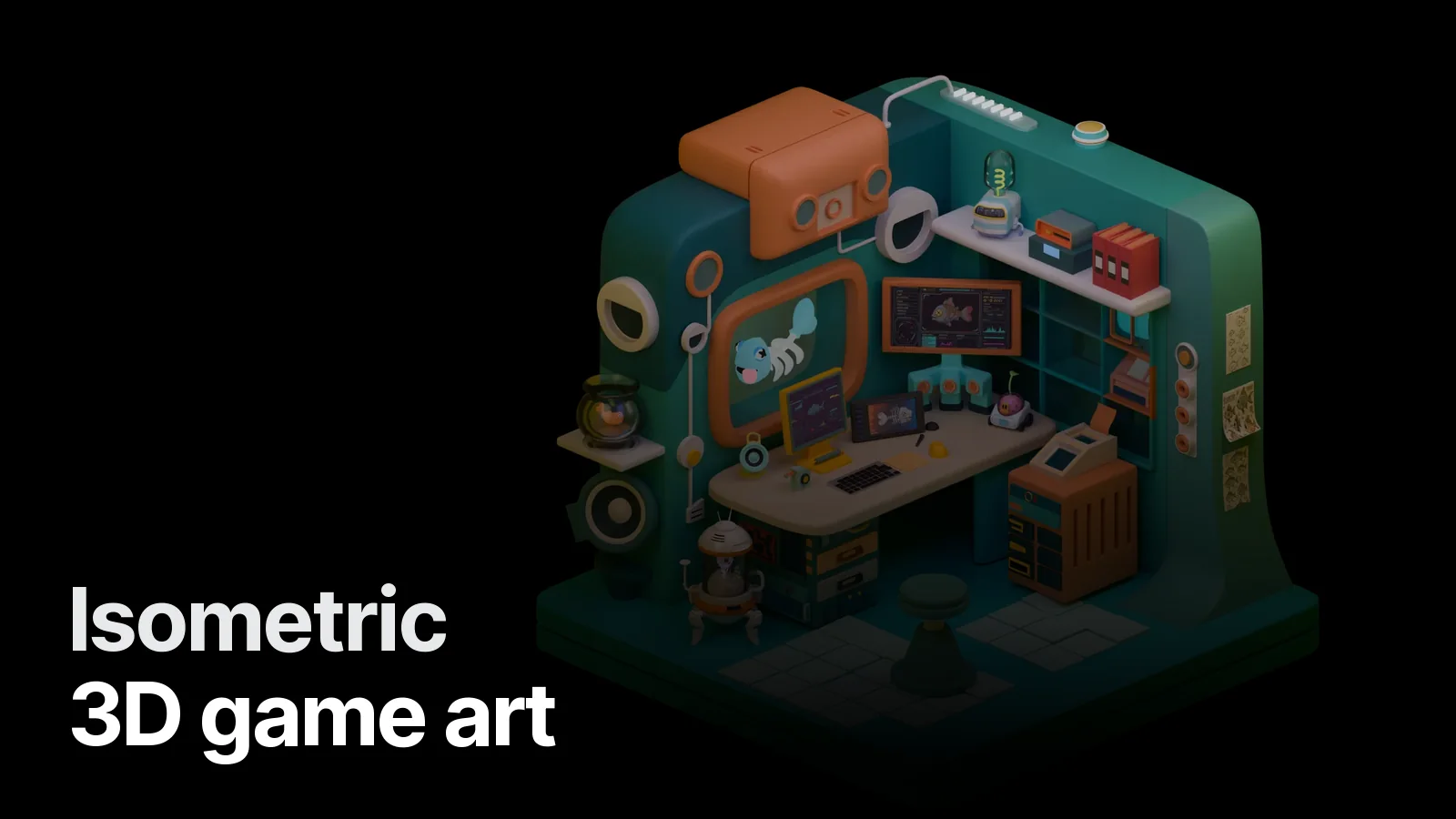
Short answer: isometric 3D art is a detailed 3D world seen through a fixed, angled camera — usually orthographic — so every scene reads like a diorama. It suits strategy, simulation, puzzle and mobile games because it is readable, modular and easy to optimise: you know exactly which faces the camera will ever see.
Camera choices
| Setup | Look | Best for |
|---|---|---|
| Orthographic, ~30°/45° | Classic isometric, grid-perfect | Tiles, city-builders, tactics |
| Orthographic, steeper angle | More top-down, clearer floor | Puzzle, management sims |
| Narrow-FOV perspective | Soft depth, cinematic | Narrative, cosy and diorama games |
Decide this before modelling — it changes proportions, which faces get detail and how tiles fit.
Modular tiles vs diorama rooms
- Modular tiles (floor, wall, corner, door, stairs) snap on a grid — ideal for procedural or player-built levels.
- Diorama rooms are composed scenes — ideal for handcrafted levels, menus and hero shots. Our Isometric Sci-Fi Room is a game-optimised diorama; Hell 06 shows the same logic in a stylised outdoor scene.
- Many games combine both: modular kit for layout, hand-placed hero props for character.
Building rules we follow
- Grid first. Every piece fits a fixed unit (e.g. 1 × 1 m) with pivots on the grid corners.
- Detail on visible faces. The back walls and hidden undersides get minimal geometry.
- Readable silhouettes at the actual zoom level — tested at phone and desktop sizes.
- Colour zoning so floors, walls, interactables and characters separate clearly.
- Shared materials and atlases to keep draw calls low (low-poly for mobile).
Lighting
A fixed camera makes baked lighting very effective: soft shadows and ambient occlusion baked into lightmaps or vertex colour, with a few real-time lights for gameplay (a lamp, a spell, a screen glow). The result looks rich and runs light.
Working with us
We build isometric rooms, tile kits and diorama scenes for Unity, Unreal and Godot. See the Game & 3D page and 3D game environment design, or send your camera setup and references on WhatsApp.
Frequently asked
1.What is isometric 3D art in games?
3D environments viewed from a fixed, angled top-down camera — usually orthographic — so the scene looks like a detailed diorama. Common in strategy, simulation, city-builder, puzzle and many mobile games.
2.Orthographic or perspective camera for isometric games?
Orthographic gives the classic isometric look with no size change by distance and is ideal for grids and tiles. A narrow-FOV perspective camera gives a softer, more cinematic feel while staying readable.
3.Why use 3D instead of 2D isometric sprites?
3D lets you rotate the camera, animate objects, change lighting and reuse modular pieces in endless combinations, while still rendering a clean isometric look.
4.Can isometric 3D run well on mobile?
Yes — the fixed camera means you know exactly what is visible, so you can bake lighting, cull aggressively and keep triangles only on faces the camera sees.