Shaders and VFX loops for games: how ice, lava, chrome, crystal and cartoon fire are made
Procedural materials and shader work: when node-based materials beat textures, displacement and vertex animation, stylised fire/portal/hologram VFX, perfect loops, porting to Shader Graph / Unreal materials, and Creatune's loop collection.
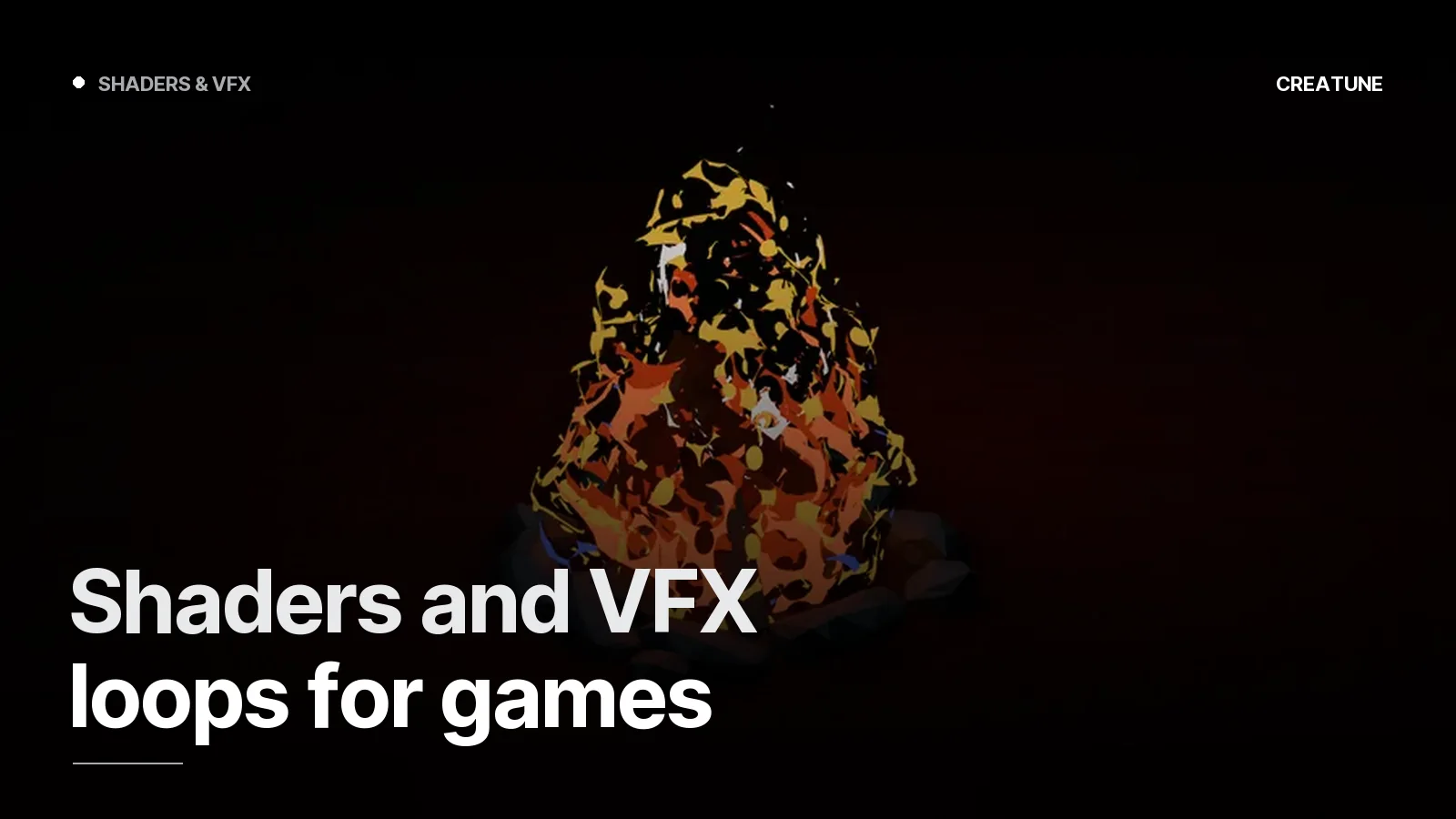
Some surfaces cannot be told with a texture: flowing lava, ice with light passing through it, turning chrome, a flickering hologram. Those are shader work — mathematics, not pixels. The loop collection on our site (chrome spiral, cartoon fire, ice, crystal, holographic planet, lava, marble, balloon dog) was produced with this approach.
Texture or shader?
| Situation | Choice |
|---|---|
| Single hero object, static surface | PBR textures |
| Large repeating surface (lava lake, ice floor) | procedural shader |
| Surface changes over time (flow, shimmer, pulse) | shader |
| Mobile, low GPU | textures (baked) or a simple shader |
| Stylised effect (fire, portal, shield) | shader + simple mesh |
Often both: the procedural material is built in Blender, the static part baked to textures, the moving part kept as a shader in the engine.
The three-layer rule (stylised VFX)
- Motion — scrolling noise (UV offset over time), vertex displacement (the mesh itself ripples). Cartoon fire: two noise layers flowing upward at different speeds.
- Colour — a gradient ramp: a heat band (yellow → orange → red → black), light bands as a horizon belt for chrome.
- Shape — alpha mask / step for a crisp edge (cel-shaded look) or a soft edge (realistic).
This trio can be rebuilt one-to-one in Unity Shader Graph and Unreal Material; the Blender nodes are designed with portable logic.
Examples from the collection
- Chrome spiral — iridescent chrome + glass; environment map plus a thin-film layer, colour shifts as the camera turns.
- Cartoon fire — displacement + ramp; no particles, one mesh.
- Ice cube — subsurface + an inner crack layer (volume) + surface wetness.
- Holographic planet — scanlines + fresnel + time-shifted noise; for UI/menus.
- Lava — flowing emissive noise + a cooled-crust mask.
- Displacement head — organic ripple via vertex displacement.
All perfect loops: the time parameter returns to the start at a full period.
In-game performance
- A small tileable noise PNG (256²) instead of a noise texture node — cheap on the GPU.
- Vertex displacement depends on mesh density; 2–10k triangles is enough.
- Fresnel + ramp is almost free; volume/subsurface is expensive → a fake version for mobile.
- Effect LOD: emissive only from afar, full shader up close.
Delivery
.blend (node network, editable), engine shader file (Shader Graph / Unreal Material) or HLSL/GLSL, baked textures + flipbook atlas (8×8 frames) if needed, MP4/WebM loop, parameter list (README).
For shader / VFX work, send references on WhatsApp; for the material-texture side, the PBR guide, for environments the environment guide.
Frequently asked
1.What is the difference between a procedural material and a texture?
A texture is a pixel map (PNG); a procedural material is a mathematical node network — it has no resolution and changes with parameters (lava flow speed, ice thickness). In the engine it is either rebuilt as a shader or baked to textures. Procedural for large repeating and animated surfaces, textures for single hero objects.
2.How are stylised fire / portal / hologram effects made?
Three layers: motion (scrolling noise and vertex displacement), colour (light bands via gradient/ramp) and shape (mask, alpha cut-off). Done as a shader it is far lighter than a particle system and loops perfectly; built in Blender and ported to Unity Shader Graph / Unreal Material.
3.What is a VFX loop?
A short animation (2–6 s) whose first and last frames match and repeats forever. Rendered for menu backgrounds, portfolios, stream screens and social media; inside a game the shader cycles on time, no image sequence needed.
4.In what format is shader work delivered?
Blender node network (.blend), Unity Shader Graph or Unreal Material file (when the engine is specified), a baked texture set and flipbook (frame sequence) atlas if needed; plus an MP4/WebM loop video.