How big game studios ship updates: seasons, patches and test servers (2026)
How studios like Riot, Epic, Valve and Blizzard plan updates: the season and Battle Pass cycle, patch schedules, test servers, hotfixes, roadmaps and update trailers. What streamers and small studios can learn from it.
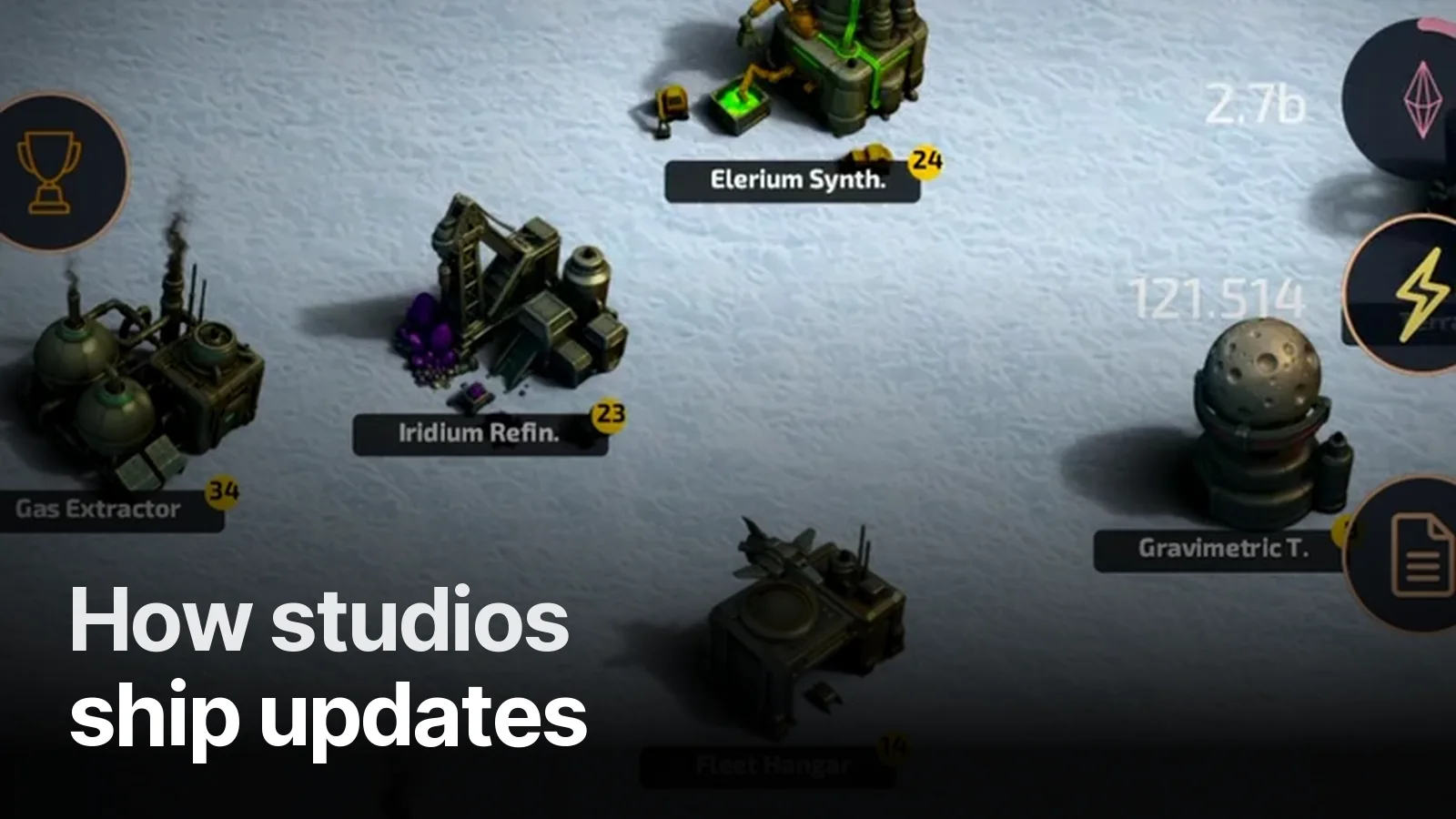
Big studios ship updates on a predictable cycle: small patches at regular intervals, a big season every few months, a new Battle Pass at the start of each season, and testing on a public test server first. Players know when something new is coming, which gives them a date to come back. For streamers, every update day is a stream topic; for small studios, it's a system worth copying.
The parts of the update cycle
| Part | What it does | Example |
|---|---|---|
| Season | A big content drop every few months: new map, mode, characters | Fortnite chapters and seasons |
| Battle Pass | Rewards unlocked across the season; keeps people playing | Fortnite, Valorant, Apex |
| Regular patch | Balance changes and bug fixes | League of Legends' fixed patch schedule |
| Test server | New content tried with a group of players first | Riot PBE, Blizzard PTR |
| Hotfix | Small off-schedule fix for an urgent bug | A broken weapon or server issue |
| Roadmap | Announces what's coming in the next months | Developer videos at season start |
| Live event | A one-time moment everyone experiences together | Fortnite season-finale events |
Why studios work this way
To create appointments. When players know "there's a patch in two weeks" or "the season ends on December 5", they don't quit; even after a break they come back on that date. Fortnite's live event for the end of Chapter 7 on December 5, 2026, with a new Battle Pass the same day, is the clearest example.
To reduce risk. Testing a big change on a test server instead of shipping it to everyone stops a bug from reaching millions of players. Riot tests new champions and changes on the PBE, Blizzard on the PTR.
To get talked about. Every update means news, patch notes, a trailer and hundreds of streams. Studios usually announce updates with an update trailer and a developer video, and sometimes give streamers and creators early access.
Different styles exist too. Valve sometimes ships big Counter-Strike 2 updates without advance notice and posts the notes afterwards, which keeps the community's "is there an update tonight?" curiosity alive.
For streamers: update day is a stream opportunity
- Patch-notes stream. Reading new patch notes with chat is popular, especially in competitive games.
- First-look stream. The first hours of a new season have the highest search traffic. Use the season name in your title.
- Live events. Go live an hour early for one-time events, with a Starting Soon screen and a countdown.
- Clips. A new weapon, a new map, your first reaction: all great short vertical videos.
For the big dates ahead, see our game release calendar.
For small studios: the same system, scaled down
You don't have a big studio's budget, but the logic works as is:
- A fixed interval. An update every month or two, so players know when to look.
- Short patch notes. Three points are enough: what's new, what's fixed, what's next.
- An update video. 15–30 seconds, showing the new thing in the first three seconds. Posted on the store page, Discord and socials at once.
- A simple roadmap. Titles of the next three updates. Players see the game is alive.
- A community moment. A small event, an end-of-season leaderboard or a new server launch. New-season launches on MMO private servers are a good example.
The fastest way to announce an update is a short video. As we did for Perregna, making several short videos from the same game with different promises also shows which feature pulls players in. See game trailers for details.
Written as of November 17, 2026, based on studios' general update practices and Epic Games' Fortnite announcement.
Your project could be next.
Get a quote on WhatsAppTrailers and ad creatives cut from real gameplay, with a strong first three seconds and readable with the sound off. Vertical + horizontal, 15 / 30 / 40 s.
What’s in it 5
- Gameplay capture (we can record it for you)
- One promise per video: growth, adventure, alliance…
- 9:16 and 16:9, 15 / 30 / 40 s cuts
- Custom music + sound design, −14 LUFS
- With-sound and silent versions, end card and CTA
Frequently asked
1.What is a live service game?
A game that receives regular content for years after launch, such as Fortnite, League of Legends, Valorant or Counter-Strike 2. Revenue comes from seasons, Battle Passes and cosmetics rather than a one-time sale.
2.What is a test server (PBE, PTR) for?
New content is tried by a group of players before it reaches live servers. Riot calls it the PBE, Blizzard the PTR. Bugs and balance problems are caught there, and streamers often see new content there first.
3.Can a small studio use this model?
In a scaled-down form, yes. Updates at a fixed interval, short patch notes, a 15–30 second video for every big update and a simple roadmap help small teams bring players back too.
4.How long should an update trailer be?
15–30 seconds is enough for stores and social media. Show what's new in the first three seconds: a new map, character or mode. A longer cut can be made for YouTube.