Mafia Hippo: from base mesh to game-ready character — a stylised 3D character case study
Case study: taking a stylised mafia hippo through base mesh → sculpt → retopo → UV → PBR textures → presentation to make it ready for games and animation. Topology decisions, wireframe, leather-fabric-metal material split, FBX + GLB delivery.
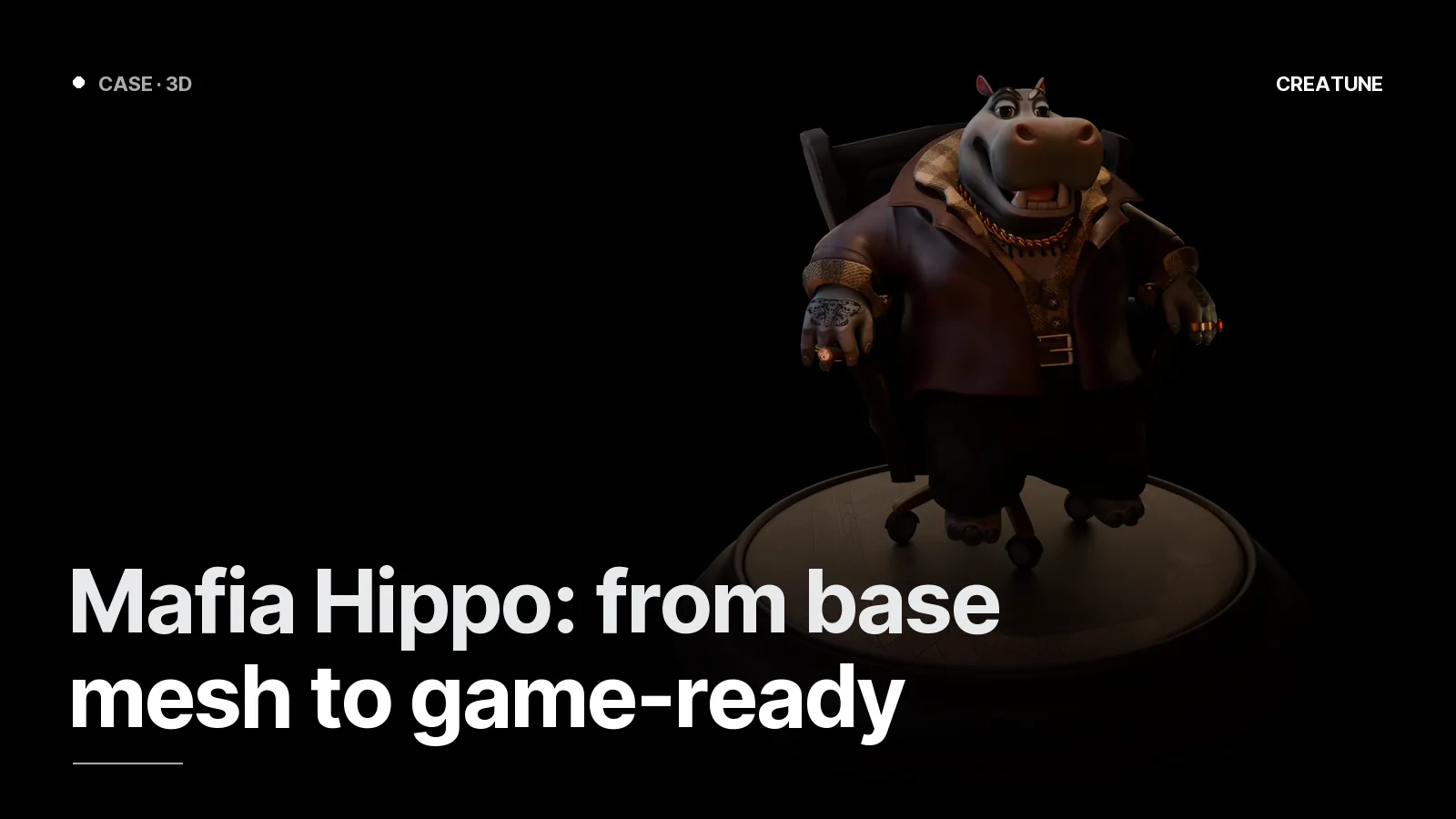
The essence of stylised character work is one sentence: the silhouette must tell the character. In Mafia Hippo, a heavy, wide body and a "boss" posture (leather jacket, plaid shirt, gold chain, cigar, office chair) read in the same silhouette. The project page is on the site — main image, alternate angle, base mesh and wireframe. This post explains the order and the decisions.
1. Base mesh: proportions get locked
The first step is proportion, not detail: head-to-body ratio, short legs, wide shoulders, a forward lean. The base mesh was built at low poly and the silhouette tested — if the character is recognisable as a shadow from three angles (front, side, 3/4), we continue. Approval happens at this stage; changing proportions later is expensive.
2. Sculpt: character language
In the high-poly sculpt the face (eyelids, lips, teeth), skin wrinkles, jacket seams and fabric folds were worked. Rule: detail serves the silhouette, never competes with it. Jacket collar, chain and cigar are the three accessories carrying the "boss" idea; all built as separate meshes so they stay manageable in retopo and texturing.
3. Retopo: animation-ready topology
A sculpt cannot enter a game; a clean mesh was built with retopo:
- Circular edge loops around the mouth and eyes (for facial expression)
- Enough segments at elbows, shoulders and fingers for deformation
- Jacket, shirt and trousers as separate parts; no intersecting surfaces
- Quad-dominant, no n-gons; wireframe on the project page
The poly budget sits at PC/console hero-character level; a mobile version can be decimated on the same UVs if needed.
4. UVs and textures: four materials, one language
The character is made of four material families: skin (grey, a hint of subsurface), leather (jacket; rough, worn at the edges), fabric (plaid shirt; weave pattern), metal (chain, belt buckle; high metallic, low roughness). PBR set — BaseColor, Normal (baked from the sculpt), Roughness, Metallic, AO. Because the stylised look rests on form rather than texture, the textures were kept "clean"; no noise. PBR guide.
5. Presentation and delivery
Turntable render, wireframe view, alternate angle; FBX + GLB, texture set in both packings (Unreal ORM / Unity Metallic-Smoothness), .blend source. If a rig is wanted, a humanoid skeleton and idle/walk set are added.
What this process teaches
- Lock proportions at the base mesh; fixing them later breaks every stage.
- Make accessories separate meshes; texturing and rigging get easier.
- In stylised characters, textures stay simple and form does the talking.
- Show the wireframe at delivery — "game-ready" is proven by topology, not by words.
A character for your own game: the Commissioning a 3D game character guide and WhatsApp. All game work: Game & 3D.
Frequently asked
1.What stages did the character go through?
Base mesh (proportions, silhouette) → sculpt (face, wrinkles, fabric folds) → retopo (clean, animation-friendly topology) → UVs → PBR textures (leather, fabric, metal, skin) → presentation (turntable, wireframe) → FBX + GLB delivery. The project page on the site shows the base, wireframe and alternate-angle images.
2.What does game-ready mean here?
A poly budget that runs in real time in a game engine, proper edge loops at deformation areas (mouth, elbows, shoulders), tidy UVs and one PBR set. The character can be rigged and animated; the high-poly sculpt was used only for baking.
3.What is the hardest part of a stylised character?
Keeping the character language: the hippo's heavy body and the mafia posture (jacket, cigar, chain) must read in the same silhouette. Proportions are locked at the base mesh; if the silhouette breaks under sculpt detail, the character is lost.
4.How long does a similar character take?
A single stylised character without a rig, at this scope, usually 7–14 days; send references and the target engine on WhatsApp for a firm timeline and price within 24 hours.