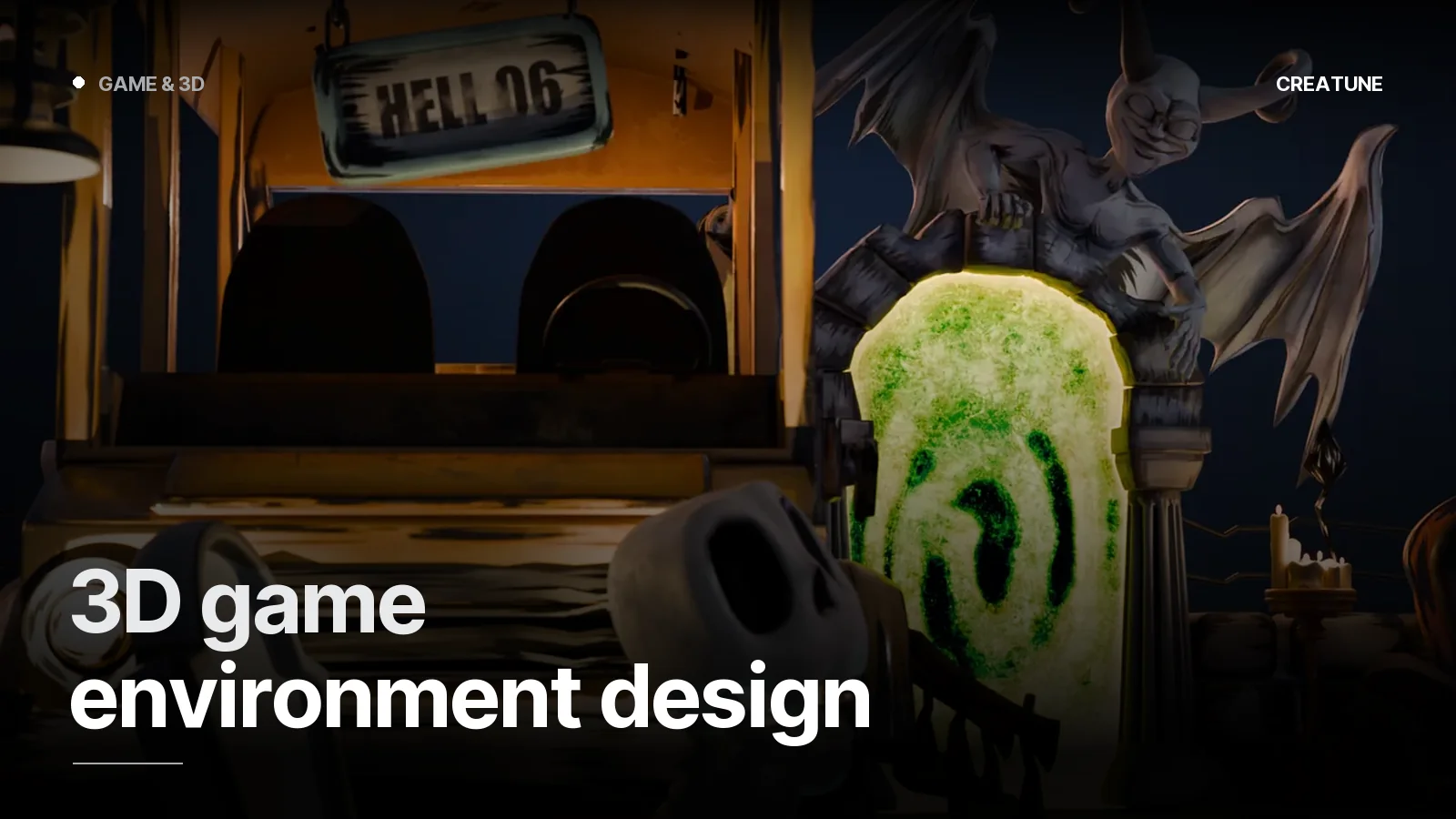
Hell 06: how a graveyard diorama was built — portal, gargoyle, cauldron and caravan
Case study: building a stylised, atmospheric graveyard scene from modular pieces. Composition first, blockout, the hero/filler prop split, atmosphere with portal light and fog, single-atlas logic, six-angle presentation.
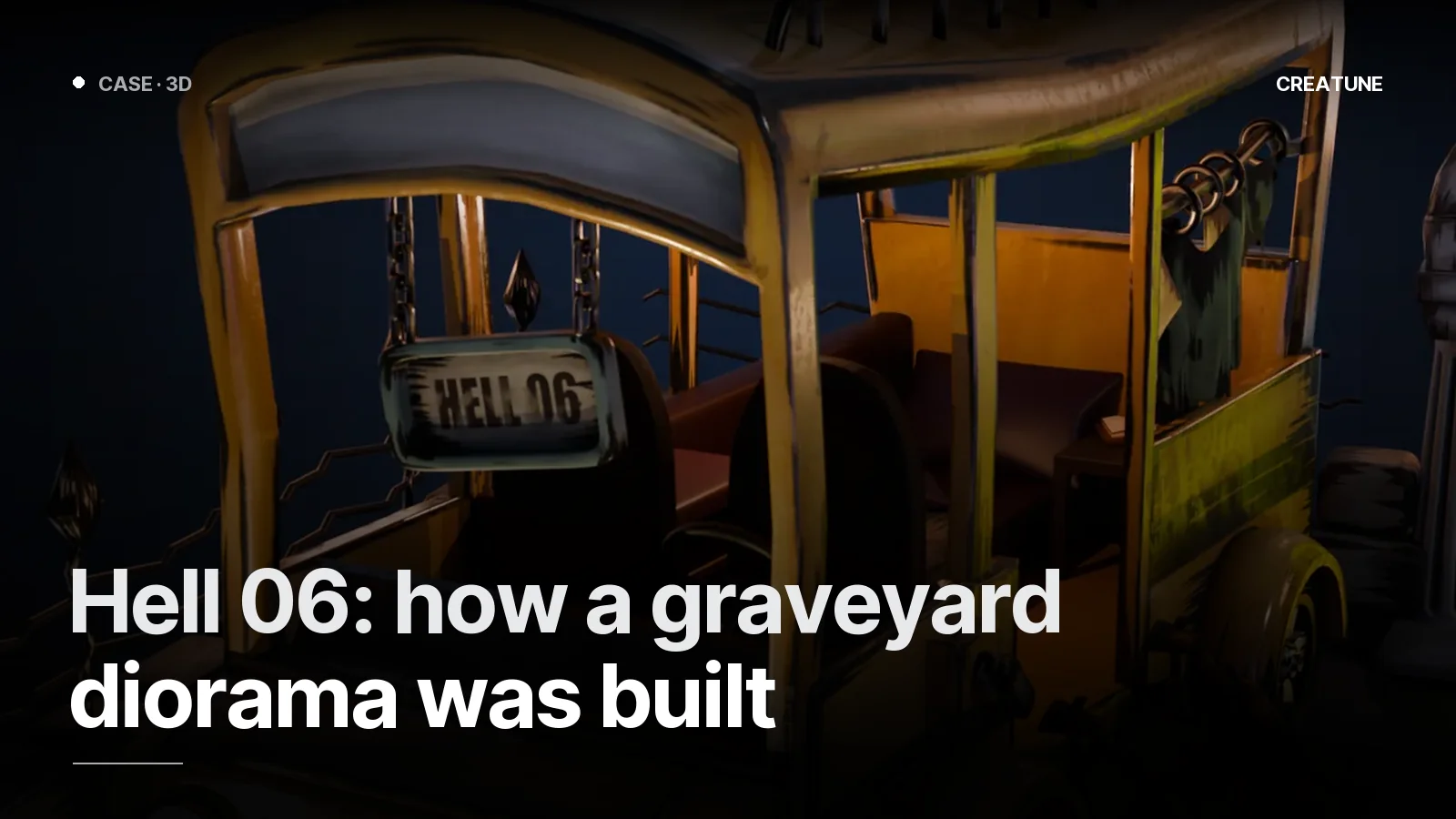
An environment diorama tells the whole game in one frame: where we are, what we feel, which story we have landed in the middle of. For Hell 06 that frame is a graveyard: a portal in the centre, a gargoyle beside it, a bubbling cauldron, an abandoned caravan. The project page is on the site, from six angles. This post explains how the scene was built.
1. Composition first
In a diorama the camera is fixed; so the framing was built before modelling. The portal is the focal point (brightest, most colourful), the gargoyle and caravan are the two masses around it, the cauldron a warm point in the foreground. A triangle composition: the eye goes to the portal, drops to the cauldron, returns to the caravan. Not a single polygon was drawn before this decision.
2. Blockout
Scale and mass with grey boxes: how big the caravan, how tall the portal, how far apart the gravestones. The blockout was rendered from the camera angle and the composition tested; two rounds of changes (caravan slightly back, portal slightly up) were made here — while cheap.
3. Pieces: hero and filler
| Class | Pieces | Approach |
|---|---|---|
| Hero | portal, gargoyle, cauldron, caravan | own textures, high detail, sculpt-supported |
| Filler | gravestones (4 variants), dead trees (3), fence pieces, rocks, skull/bones | one atlas, low poly, rotated and reused |
| Ground | soil + grass + path | tileable textures, blended with vertex colour |
The filler pieces are modular: the same gravestone in four sizes, placed at different angles; viewers do not notice the repetition because the composition differs. Hard-surface prop guide.
4. Light and atmosphere
In a stylised scene, light carries the atmosphere, not texture:
- Key light — cold, blue moonlight from above; separates the silhouettes.
- Accent — coloured light spilling from the portal; the scene's "magical" source, the brightest point.
- Contrast — the warm orange glow of the cauldron; breaks the cold palette, the eye lands there.
- Fog — low, density rising with distance; background masses soften, depth appears.
- Particles — drifting sparks / dust; gives the scene an "alive" feel.
The palette is three colours (blue, portal colour, orange); more would drown the light.
5. Optimisation
Fixed camera → unseen faces deleted, shadows and AO baked, filler pieces on one 2K atlas, hero pieces on separate 2K sets. The scene is also portable to a game engine: pieces are modular, pivots at corners, collision can be added. Environment guide.
6. Presentation
Six rendered angles: main frame, portal close-up, gargoyle, caravan, cauldron, overall high angle. Six images from one scene for portfolio, menu screen and social media — the nicest thing about a diorama.
A diorama or modular environment for your own game: write on WhatsApp with references and a piece list. All game work: Game & 3D.
Frequently asked
1.What is Hell 06?
A stylised, atmospheric graveyard diorama: portal, gargoyle, cauldron, caravan, gravestones and dead trees; one composition built from modular asset pieces with scene lighting. Six angles on the site.
2.What is the difference between a diorama and a game level?
A diorama is built by hand for one composition — portfolio, menu screen, promo image and a concept scene that conveys 'the feel of the game'. A game level is a modular kit the level designer combines. Hell 06's pieces are modular; its composition is a diorama.
3.How was the atmosphere built?
Three light layers: cold moonlight (key), coloured light from the portal (accent), warm glow from the cauldron (contrast); low fog and airborne particles on top. The palette was kept limited so the light reads.
4.How long does a similar scene take?
1–3 weeks by piece count: blockout and composition 2–3 days, pieces 1–2 weeks, lighting-atmosphere-presentation 2–3 days. Send a piece list on WhatsApp for a quote within 24 hours.